
What Is Truffle Honey? 12 Best Pairings With Cheese, Pizza, Meat, and Dessert
Truffle honey is honey infused with truffle flavor, creating a sweet and earthy condiment that works especially well with salty cheese, pizza, crostini, roasted meats, fruit, and desserts. Unlike truffle oil or truffle salt, its main advantage is contrast: sweetness softens strong, salty foods while the truffle aroma adds a savory finish.
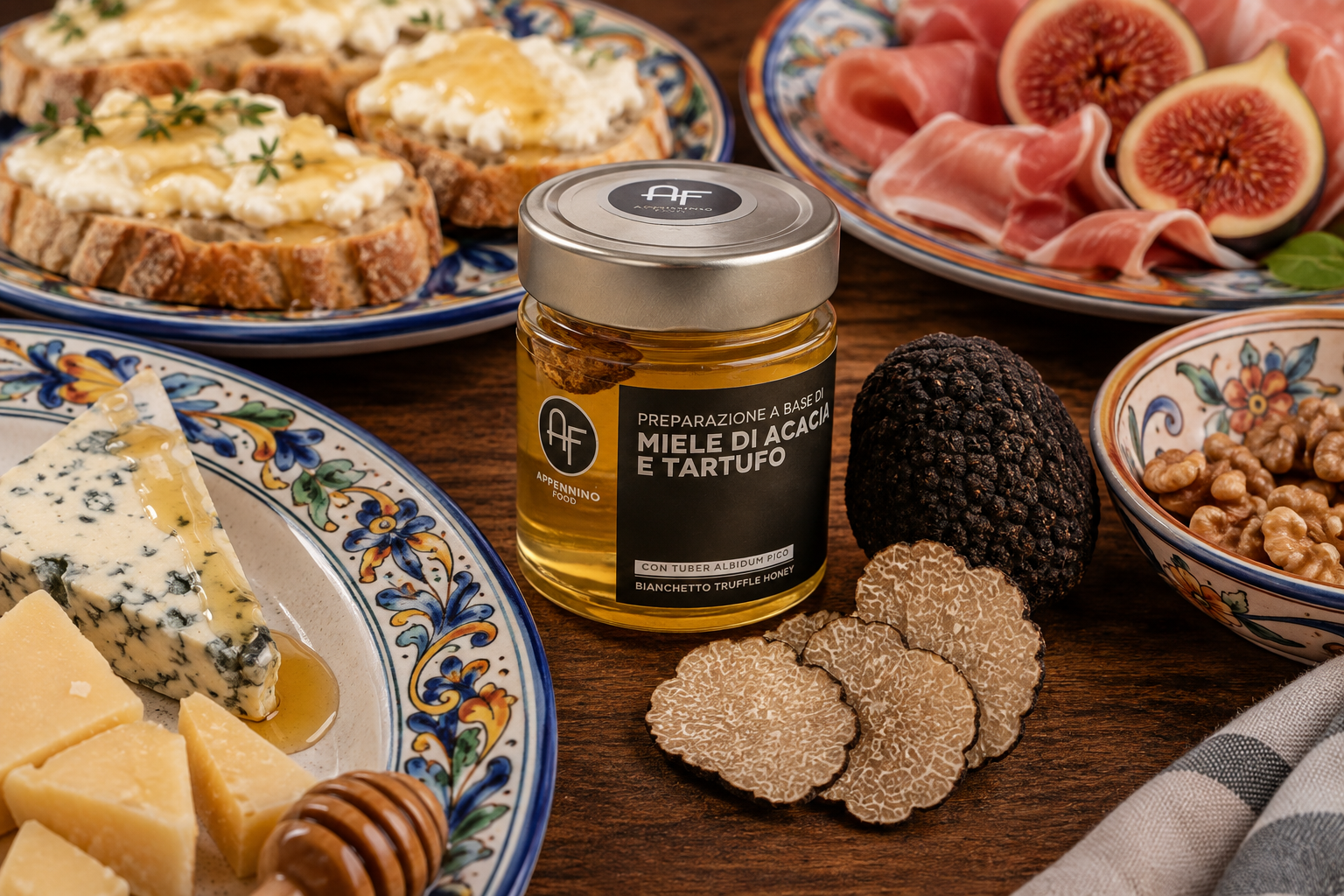
Appennino Truffle Honey is made with 99% acacia honey and the aroma of bianchetto truffle, with dried bianchetto truffle also included in the recipe. Acacia honey has a light, delicate sweetness, making it a useful base because it leaves room for the truffle character to come through instead of overwhelming it.
Key takeaways
- Truffle honey is best as a finishing ingredient, especially over cheese, pizza, crostini, meat, fruit, and dessert.
- Strong and aged cheeses are some of the best pairings, because the honey balances salt and pungency.
- Add truffle honey after cooking, rather than baking or frying it for a long time.
- A little goes a long way, so begin with a small drizzle and taste before adding more.
- Appennino Truffle Honey uses acacia honey, a mild honey that works particularly well with savory foods.
What is truffle honey?
Truffle honey combines the sweetness of honey with the earthy, aromatic character associated with truffles. The result sits somewhere between a condiment and a finishing sauce. It is sweet enough to use with dessert, but savory enough to pair naturally with cheese, meat, mushrooms, and bread.
That versatility makes truffle honey different from most other truffle products. Truffle oil is primarily an aromatic finishing fat. Truffle salt seasons food. Truffle sauce adds mushrooms, olives, truffle, and texture. Truffle honey is the option to choose when the dish needs sweetness and truffle aroma at the same time.
Appennino's version begins with acacia honey, which is appreciated for its light flavor and smooth texture. The current recipe contains 99% acacia honey, flavoring, and 0.05% dried bianchetto truffle, listed as Tuber albidum Pico.
It is available in 50g and 170g sizes and is gluten-free.
The easiest rule for truffle honey: pair it with foods that are salty, creamy, earthy, or mildly bitter. The sweetness creates contrast while the truffle aroma connects naturally with cheese, mushrooms, meat, and warm bread.
What does truffle honey taste like?
The first flavor is still honey. Expect sweetness and a smooth texture, followed by a savory, earthy truffle aroma. The combination is unusual because the flavor moves in two directions at once.
This is why truffle honey works particularly well with ingredients such as Parmigiano Reggiano and Gorgonzola. A strong cheese may be salty, sharp, nutty, or pungent. Honey softens those edges, while truffle adds another savory layer.
If you are new to truffle flavors in general, the guide to what foods go best with truffles explains why simple foods with fat, salt, and warmth tend to be the most reliable pairings.
12 best foods to pair with truffle honey
1. Parmigiano Reggiano
Parmigiano Reggiano is one of the easiest places to start. Its salty, nutty, aged flavor contrasts beautifully with honey. Break the cheese into irregular chunks rather than cutting it into perfect slices, then add a very small drizzle of truffle honey just before serving.
This works as a simple appetizer, part of an Italian cheese board, or a final course after dinner.
2. Gorgonzola
Blue cheese and honey are already a classic sweet and savory combination. Adding truffle makes the pairing deeper and more aromatic.
Gorgonzola's pungent, salty character can handle a stronger condiment, so this is one of the pairings where the truffle honey does not disappear. Serve it with toasted bread, walnuts, or pears.
3. Pecorino
Aged pecorino is salty and assertive, which makes it another excellent match. Younger pecorino gives a softer, creamier pairing, while an aged version produces more contrast.
Serve small pieces with truffle honey, crackers, and nuts for an easy antipasto.
4. Brie, Taleggio, or other creamy cheeses
Soft cheese gives truffle honey a completely different texture. Warm Brie, Taleggio, Camembert, or a mild goat cheese provides enough fat and creaminess to carry the truffle aroma while the honey gives the dish a sweet finish.
This is especially useful when building a cheese board because you can offer both a strong pairing, such as Gorgonzola, and a milder option.
5. White pizza with cheese and mushrooms
Pizza is one of the best ways to use truffle honey, particularly when the base is white rather than heavily tomato-forward. Mozzarella, mushrooms, Parmigiano, ricotta, sausage, and béchamel all work well.
Bake the pizza normally, then drizzle the honey on after it comes out of the oven. Appennino's Gourmet Pizza with Truffle Honey uses mushrooms and a creamy base to build around exactly this sweet and savory contrast.
6. Prosciutto and crostini
Prosciutto provides salt and richness, toasted bread provides crunch, and truffle honey brings sweetness and aroma. Add a soft cheese such as ricotta or stracciatella and you have an appetizer that takes only minutes to assemble.
Keep the honey light. It should accent the prosciutto rather than turn the crostini into dessert.
7. Roast pork
Pork naturally works with sweet ingredients such as honey, apples, pears, and fruit mostarda. Truffle honey can be used in the same way, but with a more savory finish.
Roast or grill the pork normally, then use a very small drizzle at the table. Do not coat the meat heavily before cooking because prolonged high heat reduces the advantage of using an aromatic finishing ingredient.
8. Steak
Steak and honey may sound unusual, but the combination works when used with restraint. A few drops of truffle honey next to sliced beef can create a sweet contrast to the browned, savory crust.
For a completely savory steak pairing, choose Truffle Sauce instead. Truffle honey is the more creative option when you specifically want a sweet and savory plate.
9. Roasted vegetables
Carrots, squash, parsnips, cauliflower, and onions become naturally sweeter as they roast. A small amount of truffle honey can reinforce that caramelized flavor while adding an earthy finish.
Roast the vegetables with regular olive oil, salt, and pepper. Add truffle honey only after they come out of the oven.
10. Pears, figs, and apples
Fruit makes an easy bridge between cheese and dessert. Pears work particularly well with blue cheese, while figs pair naturally with aged cheese and cured meat.
Try slices of pear with Gorgonzola and truffle honey, or figs with Parmigiano and a few drops of honey. Apples are a simpler everyday option.
11. Vanilla ice cream or panna cotta
Truffle honey can also be used as a dessert condiment. Vanilla ice cream, panna cotta, mascarpone cream, or a mild cheesecake provides a neutral base that lets the sweet and earthy contrast stand out.
Use much less than you would use ordinary dessert syrup. The goal is to create a surprising aromatic finish rather than make the dessert taste strongly savory.
12. Warm bread with butter or soft cheese
One of the simplest pairings is also one of the best. Toast sourdough, ciabatta, focaccia, or a baguette and serve it warm with butter, ricotta, mascarpone, Brie, or another creamy cheese.
Drizzle truffle honey over the top just before eating. For another truffle-forward bread idea, the truffle butter guide includes crostini combinations with cheese, mushrooms, eggs, and prosciutto.
Truffle honey pairing chart
| Food | Why it works | How to serve it |
|---|---|---|
| Parmigiano Reggiano | Salty and nutty against sweet honey | Drizzle over broken chunks at room temperature |
| Gorgonzola | Pungent blue cheese balances sweetness | Serve with bread, walnuts, or pear |
| Pecorino | Sharp sheep's milk cheese creates contrast | Pair with crackers and nuts |
| White pizza | Cheese and mushrooms complement truffle aroma | Drizzle after baking |
| Prosciutto | Salt and fat balance the honey | Serve on crostini with soft cheese |
| Roast pork | Pork naturally works with sweet finishes | Add lightly after cooking |
| Fruit | Natural sweetness bridges cheese and dessert | Use with pears, figs, or apples |
| Ice cream | Neutral creaminess highlights the unusual aroma | Use a very small drizzle |
How to build a cheese board with truffle honey
You do not need a complicated board. The easiest approach is to choose three cheeses with different personalities.
- One hard cheese: Parmigiano Reggiano or aged pecorino.
- One strong cheese: Gorgonzola or another blue cheese.
- One creamy cheese: Brie, Taleggio, goat cheese, or ricotta.
Add warm bread or plain crackers, walnuts or hazelnuts, and fresh pear or figs. Place the truffle honey in the center and let guests decide which combinations they prefer.
A cheese board is also one of the easiest ways to compare truffle honey with a savory condiment. Add a small bowl of Appennino Truffle Sauce for crostini and you have both sweet and savory truffle options on the same table.
Truffle honey vs regular honey
Regular honey is more versatile when you simply need sweetness. Truffle honey is more specialized. You buy it because you want the honey to contribute an aroma of its own.
That makes regular honey the better choice for tea, breakfast, everyday baking, and recipes where honey disappears into the other ingredients. Truffle honey makes more sense when it is visible and tasted at the end.
| Option | Main character | Best uses |
|---|---|---|
| Regular honey | Sweet, floral, varies by honey type | Tea, baking, breakfast, marinades, desserts |
| Truffle honey | Sweet with an earthy, savory truffle aroma | Cheese, pizza, crostini, meat, fruit, specialty desserts |
When should you add truffle honey?
Use it at the end. This is the same general principle that applies to many aromatic truffle products.
Bake the pizza first. Roast the vegetables first. Cook and rest the meat first. Toast the bread first. Then add the honey.
Finishing gives you more control over the sweetness and keeps the aroma noticeable. You can always add another drop, but it is much harder to remove honey once a dish becomes too sweet.
How much truffle honey should you use?
Start with less than ordinary honey. On cheese, a few drops may be enough for one bite. On pizza, use thin lines rather than covering the surface. On meat, think of it as a condiment rather than a glaze.
The best amount depends on how strong and salty the food is. Gorgonzola can take more than Brie. A savory mushroom pizza can take more than vanilla ice cream.
Taste after every addition. Truffle honey should create contrast without making every bite taste primarily of honey.

Recommended product: Appennino Truffle Honey
Acacia honey paired with bianchetto truffle aroma for cheese boards, pizza, crostini, roasted meats, fruit, and creative desserts.
View Truffle HoneyCommon mistakes with truffle honey
Using too much
Honey is already concentrated. The truffle aroma makes it even more noticeable. Start with a few drops rather than pouring it like a sauce.
Cooking it for too long
Use truffle honey as a finish whenever possible. Long cooking changes both honey and truffle aroma.
Pairing it with an already very sweet dish
The most interesting part of truffle honey is contrast. Pairing it with extremely sweet desserts can remove that contrast. Mild desserts are usually better.
Adding too many competing flavors
Very spicy sauces, heavy vinegar, strong citrus, or heavily smoked foods can make the truffle harder to notice. Keep the underlying dish relatively simple.
Expecting it to replace truffle oil or truffle sauce
Each product has a different purpose. Truffle honey adds sweetness. Truffle oil adds aroma and fat. Truffle salt seasons. Truffle sauce adds savory mushroom texture. Choose the format according to the dish.
If you are comparing other truffle formats, read Truffle Salt vs Truffle Oil or the guide to black truffle vs white truffle.
Frequently asked questions
What is truffle honey?
Truffle honey is honey combined with truffle aroma, truffle pieces, or both. It is used mainly as a finishing condiment for sweet and savory foods.
What does truffle honey taste like?
It tastes sweet like honey with an earthy, savory truffle aroma. The exact balance depends on the honey and truffle ingredients used in the product.
What cheese goes best with truffle honey?
Parmigiano Reggiano, Gorgonzola, aged pecorino, Brie, Taleggio, goat cheese, and other salty or creamy cheeses are excellent choices.
Does truffle honey go with Parmigiano Reggiano?
Yes. Parmigiano Reggiano is one of the easiest pairings because its salty, nutty flavor contrasts with the sweetness of the honey while working naturally with truffle aroma.
Does truffle honey go with blue cheese?
Yes. Gorgonzola and other blue cheeses pair especially well because their strong, salty character can balance the sweetness of the honey.
Can you put truffle honey on pizza?
Yes. It works particularly well on white pizza with mozzarella, mushrooms, ricotta, Parmigiano, sausage, or other savory toppings. Drizzle it on after baking.
Can you use truffle honey with meat?
Yes. Roast pork, prosciutto, and even steak can work with a small amount of truffle honey. Use it sparingly as a finishing condiment.
Can truffle honey be used for dessert?
Yes. Try a small drizzle over vanilla ice cream, panna cotta, mascarpone, mild cheesecake, or fresh fruit.
Should truffle honey be cooked?
It can be used in cooking, but it is usually more effective as a finishing ingredient. Adding it after cooking gives you better control over both sweetness and aroma.
What is in Appennino Truffle Honey?
The current recipe contains 99% acacia honey, flavoring, and 0.05% dried bianchetto truffle, listed as Tuber albidum Pico. It is gluten-free.
Ready to try truffle honey?
Start with Parmigiano Reggiano, Gorgonzola, warm bread, or a white mushroom pizza. A small drizzle is enough to add sweetness and truffle aroma to an otherwise simple dish.
Shop Appennino Truffle Honey```
Read more
A good ready-made Cacio e Pepe sauce should put Pecorino Romano and black pepper at the center, not taste like a generic cream sauce. Learn what to check on the label and how to turn a jar into a r...
Truffle sauce adds mushroom texture and savory depth, while truffle oil adds aroma and olive oil richness. Learn which to choose for pasta, risotto, steak, eggs, and crostini, with practical servin...