
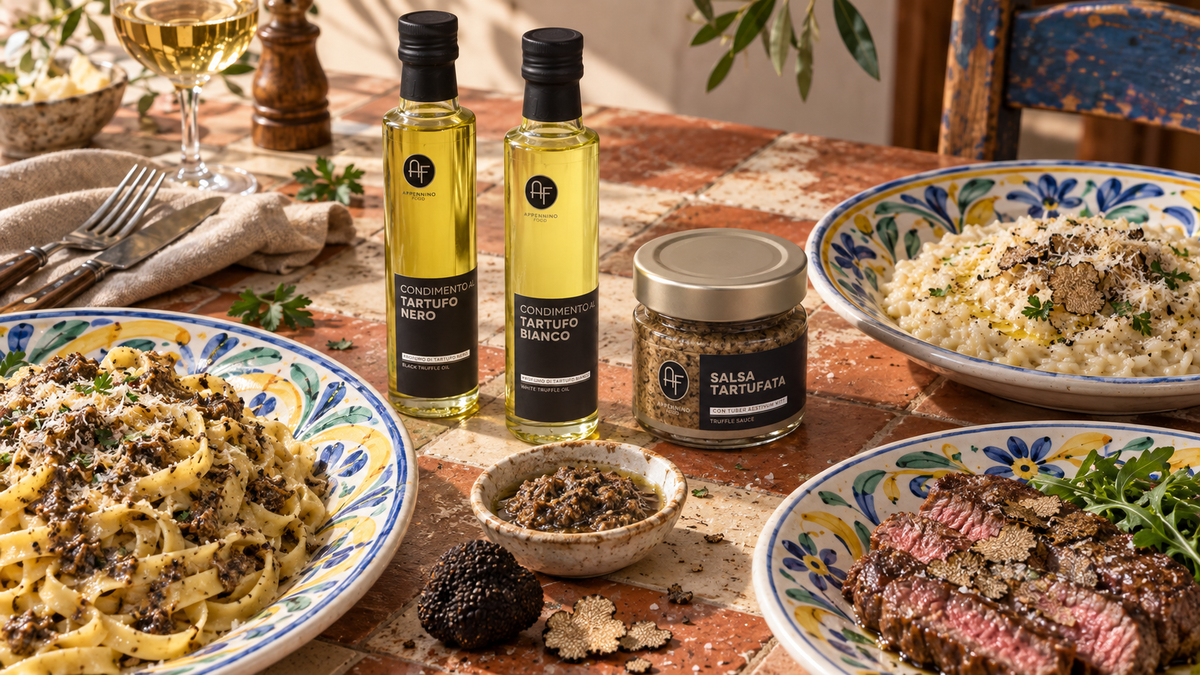
Truffle Sauce vs Truffle Oil: Which Is Better for Pasta, Risotto, and Steak?
Choose truffle sauce when you want actual texture, mushrooms, and a rich savory component in the dish. Choose truffle oil when the food is already finished and you mainly want to add truffle aroma without changing its texture. For pasta and crostini, truffle sauce is often the stronger choice. For risotto, eggs, potatoes, vegetables, and simple steak, truffle oil is one of the easiest finishing ingredients.
The two products are not interchangeable. Appennino Truffle Sauce, also known as salsa tartufata, combines champignon mushrooms, summer truffle, black olives, and olive oil into a coarse, spoonable sauce. Appennino Black Truffle Olive Oil uses extra virgin olive oil as the base and is designed to be used a few drops at a time. If you cook with truffle frequently, both belong in a well rounded truffle pantry.
Key takeaways
- Truffle sauce adds flavor and texture, making it especially useful for pasta, crostini, steak tartare, sandwiches, and roasted meat.
- Truffle oil mainly adds aroma, so it is ideal when the dish already has the texture and richness you want.
- For pasta, use sauce when you want a fuller mushroom truffle dish, and oil when you want a lighter finishing touch.
- For risotto, truffle oil is usually the easier choice, but a small spoonful of truffle sauce can add extra body and mushroom flavor.
- For steak, choose according to the result you want: truffle sauce for a savory accompaniment, truffle oil for a clean aromatic finish.
What is truffle sauce?
Truffle sauce, often called salsa tartufata in Italy, is a savory spread or condiment built around mushrooms and truffle. Unlike truffle oil, it contains solid ingredients, so it changes both the flavor and the texture of a dish.
Appennino Truffle Sauce contains 50% champignon mushrooms, olive oil, 3.2% summer truffle, black olives, salt, and flavouring. The ingredients are finely chopped rather than blended completely smooth, giving the sauce a coarse texture that works particularly well on pasta and toasted bread.
Because mushroom is the main ingredient, truffle sauce tastes fuller and more substantial than oil. You get mushroom flavor, olive richness, salt, truffle aroma, and visible texture in the same spoonful.
This makes truffle sauce useful when the dish needs more than aroma. The broader guide to foods that go best with truffles explains why mushrooms, pasta, meat, and bread are such natural partners.
What is truffle oil?
Truffle oil is an aromatic oil commonly used to finish warm or cold food. It does not create a sauce by itself and does not add mushroom texture.
Appennino Black Truffle Olive Oil is based on Italian extra virgin olive oil and contains 0.2% dried black winter truffle, listed as Tuber melanosporum Vitt., plus flavouring. The oil comes in a 60ml size for occasional home use as well as larger formats.
A couple of drops can be enough because the purpose is aroma, not volume. It works best when the food already has enough richness from butter, cheese, egg yolk, cream, meat, or olive oil.
For a deeper look at choosing a bottle, see the Best Truffle Oils 2026 comparison.
The easiest rule: if you want to spoon something onto the dish, choose truffle sauce. If you want to drizzle something over the dish, choose truffle oil.
Truffle sauce vs truffle oil: quick comparison
| Characteristic | Truffle sauce | Truffle oil |
|---|---|---|
| Texture | Coarse, spoonable, with visible mushroom pieces | Liquid oil |
| Main role | Adds savory flavor, mushroom body, and truffle aroma | Adds truffle aroma and olive oil richness |
| Best for | Pasta, crostini, steak tartare, roasted meat, sandwiches | Risotto, eggs, potatoes, pasta, polenta, vegetables, steak |
| How much to use | Usually measured by spoonfuls | Usually measured by drops or a light drizzle |
| When to add | Near the end of cooking or at serving | Primarily as a finishing ingredient |
| Best Appennino choice | Appennino Truffle Sauce | Appennino Black Truffle Olive Oil |
Which is better for pasta?
For a full truffle pasta, truffle sauce is usually the better starting point. The mushroom base gives the pasta body and produces a sauce that actually clings to the noodles.
Cook tagliatelle, pappardelle, fettuccine, rigatoni, or gnocchi until al dente. Warm a spoonful or two of truffle sauce in a pan with a little butter or pasta water, then add the pasta and toss until coated.
Parmigiano Reggiano can be added at the end. Keep garlic, chili, tomato, and strong herbs restrained because they can compete with the truffle aroma.
When truffle oil is better for pasta
Use truffle oil when the pasta already has a sauce. Butter and Parmigiano pasta, creamy mushroom pasta, Cacio e Pepe, or a mild cheese sauce may already have enough body. A few drops of truffle oil can add aroma without making the plate heavier.
You can also combine the two. Use a small amount of truffle sauce to build the pasta, then finish the plate with one or two drops of oil for extra aroma. The key is restraint.
Which is better for risotto?
Truffle oil is usually the easiest choice for risotto because risotto already has a creamy texture. Butter, Parmigiano Reggiano, starch, and stock create enough body on their own.
Cook the risotto completely, finish it with butter and cheese, then remove it from the heat. Add a few drops of truffle oil immediately before serving. The warmth of the rice helps release the aroma.
If you want a stronger mushroom profile, use a small spoonful of truffle sauce near the end instead. This works particularly well with porcini or mixed mushroom risotto. Appennino's guide to dried porcini mushrooms explains how to build a deeper mushroom base and use the soaking liquid.
Which is better for steak?
Both work, but they create different plates.
Use truffle sauce when you want a condiment beside the steak. Spoon a small amount next to sliced beef or serve it on crostini alongside the meat. The mushrooms and olives give the steak a more substantial savory accompaniment.
Use black truffle oil when you want the steak itself to remain the center of the plate. Rest the steak, slice it, then add only a few drops over the surface immediately before serving.
For grilled beef, roast beef, filet mignon, or steak with potatoes, start with the black truffle oil when you want an aromatic finish without a mushroom topping.
Which is better for crostini and appetizers?
Truffle sauce wins here. Its thick texture makes it easy to spread onto toasted bread without running off the surface.
Toast slices of baguette or ciabatta, then spread on a thin layer of truffle sauce. You can serve it alone or add ricotta, Parmigiano Reggiano, mild goat cheese, prosciutto, or sautéed mushrooms.
Truffle oil can still be used, but it works better as the final drop rather than the main topping. A crostino with ricotta and mushrooms, for example, can be finished with a tiny drizzle of White Truffle Olive Oil for a more aromatic profile.
Which is better for eggs?
Truffle oil is usually the better option for eggs. Scrambled eggs, fried eggs, omelets, and soft boiled eggs already have their own creamy texture, so they do not need another chunky sauce.
Finish the eggs with a few drops of oil after cooking. White truffle oil is especially good here because its more aromatic profile works well with eggs, butter, and mild cheese.
The guide to black vs white truffle explains why different truffle profiles suit different foods.
Which is better for potatoes?
Truffle oil is the more flexible choice for fries, roasted potatoes, mashed potatoes, and potato gratin. Add it after cooking, while the potatoes are still hot.
Truffle sauce works better when potatoes are part of a larger plated dish, such as mashed potatoes under steak or roasted potatoes served with meat. A spoonful next to the plate acts more like a savory condiment.
If the potatoes still need seasoning as well as truffle flavor, the guide to Truffle Salt vs Truffle Oil can help you choose the better finishing product.
Can you use truffle sauce and truffle oil together?
Yes, but use less of each than you would use alone.
The best approach is to let truffle sauce provide the body and let the oil provide the final aroma. Pasta is the clearest example. Toss pasta with a small amount of truffle sauce, then finish the plated dish with one or two drops of oil.
The same technique works with risotto and polenta. The sauce creates mushroom depth while the oil creates aroma above the dish.
Do not assume that doubling the number of truffle products automatically makes the dish better. The food underneath should still taste like pasta, rice, steak, or potatoes.
Black truffle oil or white truffle oil?
Once you choose oil, the next question is black or white.
Black truffle olive oil is usually the easier all purpose option. It works particularly well with mushrooms, potatoes, steak, roasted meat, polenta, vegetables, and creamy pasta.
Appennino White Truffle Olive Oil is made with extra virgin olive oil, 0.2% dried bianchetto truffle (Tuber albidum Pico), and flavouring. Try it with eggs, risotto, buttered pasta, and fresh cheese. This is a bianchetto-based oil, not a bottle of fresh white Alba truffle.
If you are buying your first bottle, black truffle oil is generally the most flexible choice. If the aroma itself is meant to be the star of a very simple dish, white truffle oil may be the better option.
How much should you use?
Truffle sauce
Start with about one spoonful for a small portion of pasta, risotto, or meat. Taste before adding more. Because the sauce contains mushrooms, olives, oil, salt, and truffle, it changes the dish more dramatically than oil.
Truffle oil
Start with only a few drops per serving. You can add more after tasting, but you cannot easily remove an excessive amount once it has been drizzled over the food.
For these serving suggestions, treat the quantities as starting points, not fixed manufacturer portions. Taste the food and adjust gradually.

Recommended product: Appennino Truffle Sauce
Italian salsa tartufata made with 50% champignon mushrooms, summer truffle, black olives, and olive oil for pasta, crostini, steak tartare, and roasted meats.
View Truffle SauceCommon mistakes when using truffle sauce or oil
Using too much
Both products are concentrated. Begin with less than you think you need, especially with truffle oil.
Cooking truffle oil aggressively
Truffle oil is generally more useful as a finishing ingredient. Add it near the end or directly to the plated food rather than using it as the main frying oil.
Expecting truffle sauce to behave like oil
Truffle sauce adds mushrooms, olives, salt, fat, and texture. It will change the structure of a dish, not simply its aroma.
Using strong competing flavors
Large amounts of vinegar, chili, smoke, citrus, or heavy tomato sauce can make the truffle harder to notice. Keep the underlying dish simple.
Choosing based only on intensity
The better question is what the dish needs. If it needs texture and savory depth, use sauce. If it already has enough body and simply needs aroma, use oil.
How to store the jar and bottles
Store Appennino Truffle Sauce in a cool, dry place and refrigerate it after opening. Store the classic black and white truffle olive oils away from light and heat. Keep containers closed and follow the current package instructions; the product pages do not specify a universal number of days to use every opened product.
Shop the finishing oils

Appennino Black Truffle Olive Oil
Choose a few drops for meat, vegetables, bruschetta, or soft polenta.
View Black Truffle Olive Oil
Appennino White Truffle Olive Oil
Try a few drops with pasta, rice, cheese, and eggs.
View White Truffle Olive OilFrequently asked questions
Is truffle sauce the same as truffle oil?
No. Truffle sauce is spoonable and contains solid ingredients such as mushrooms and truffle. Truffle oil is a liquid oil that adds aroma and richness without mushroom texture.
Which is better for pasta, truffle sauce or truffle oil?
Choose sauce when pasta needs a mushroom-based coating. Choose oil when pasta already has butter, cheese, or another sauce and you want a small aromatic finish.
Which is better for risotto?
Oil is useful when the risotto already has the creamy texture you want. Sauce adds mushroom flavor and visible texture. Stir sauce in near the end, or add oil after taking the risotto off the heat.
Which is better for steak?
Use truffle sauce as a mushroom condiment beside sliced steak. Use a few drops of black truffle oil on the rested meat when you prefer an aromatic finish without a chunky topping.
Can you use truffle sauce and truffle oil together?
Yes. Let sauce provide the mushroom base, taste the dish, then add a little oil only if you want more aroma. Use less of each than you would use alone.
What is salsa tartufata?
Salsa tartufata is an Italian truffle sauce or condiment. Recipes vary. Appennino's version contains champignon mushrooms, olive oil, summer truffle, black olives, salt, and flavouring.
Does Appennino Truffle Sauce contain real truffle?
Yes. Its current ingredient list identifies 3.2% summer truffle, Tuber aestivum Vitt., alongside 50% champignon mushrooms. It also contains flavouring.
Does Appennino Black Truffle Olive Oil contain real truffle?
Yes. The classic Black Truffle Olive Oil lists extra virgin olive oil, 0.2% dried black truffle, Tuber melanosporum Vitt., and flavouring. Do not confuse this formula with other Appennino oil ranges.
What truffle is used in Appennino White Truffle Olive Oil?
The classic White Truffle Olive Oil lists 0.2% dried bianchetto truffle, Tuber albidum Pico, together with extra virgin olive oil and flavouring.
Can you fry with truffle oil?
For these dishes, use your usual cooking oil to fry or sear, then add truffle oil as a finish. This gives you more control over the aroma and avoids using the flavored oil as the main frying fat.
How much truffle sauce or oil should you use?
As a practical starting point, try about one spoonful of sauce for a small serving, or only a few drops of oil. Taste before increasing the amount. Product intensity, serving size, and personal preference vary.
How should you store truffle sauce and truffle oil?
Appennino directs customers to keep Truffle Sauce in a cool, dry place and refrigerate it after opening. Its classic black and white truffle olive oils should be stored away from light and heat. Follow the current package for any additional instructions.
Choose the right truffle finish for your next meal
Start with sauce for a mushroom-rich pasta or crostini. Pick oil when your risotto, steak, or eggs need a finishing aroma. Choose the texture you want first, then season to taste.
Explore Appennino Truffle ProductsRead more
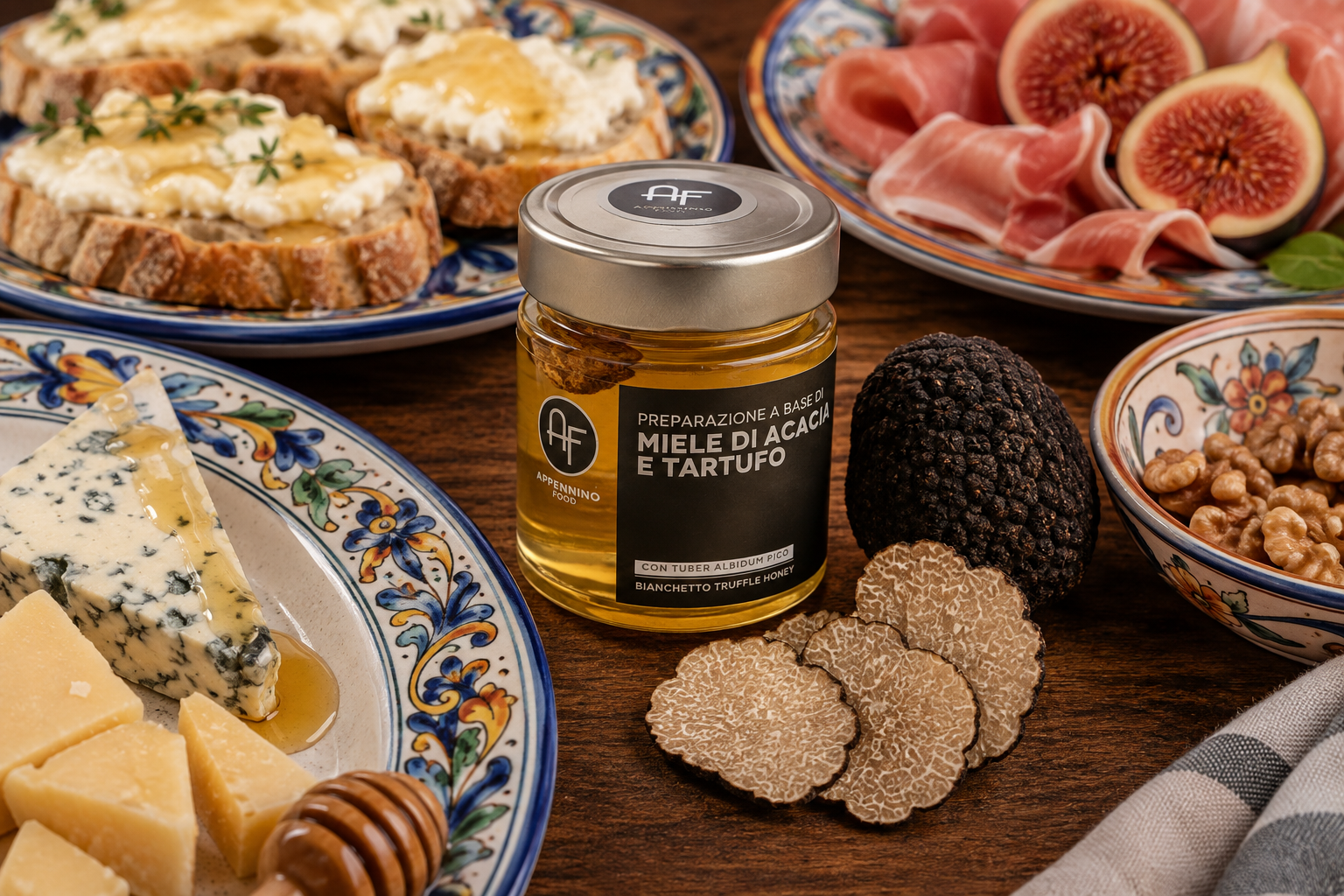
Truffle honey combines sweet honey with earthy truffle aroma for an easy sweet and savory finishing ingredient. Discover the best cheeses, pizzas, meats, breads, and desserts to pair with it.
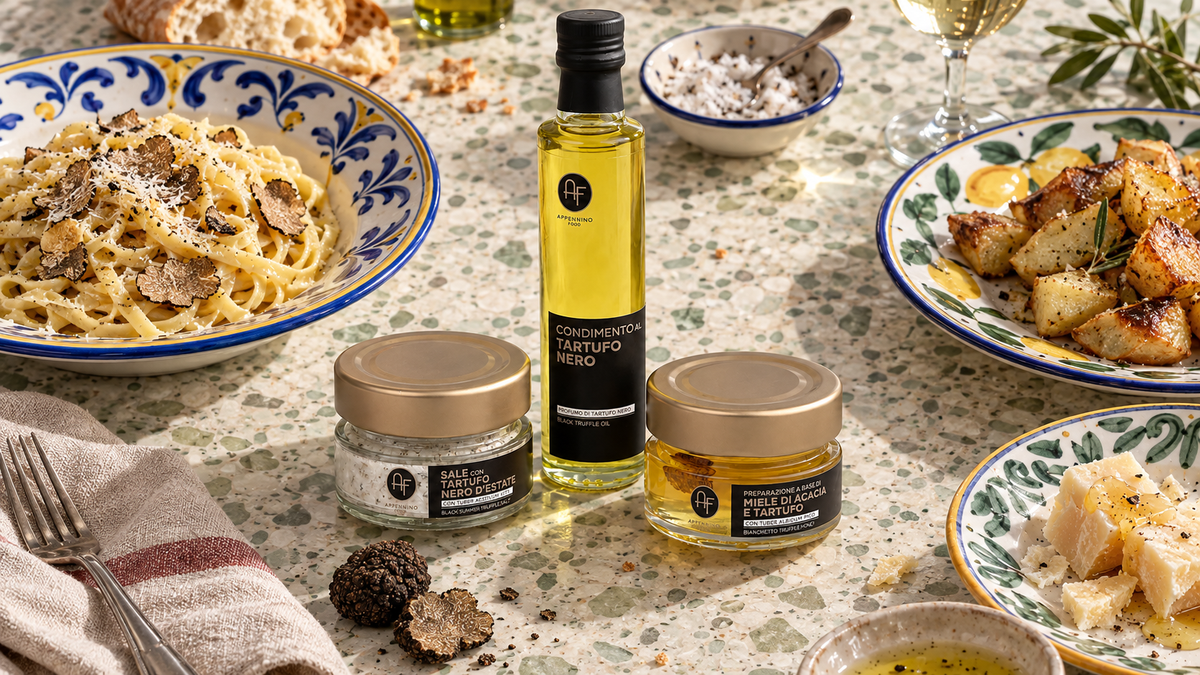
Buying Italian truffle products starts with the producer, ingredients, and the meal you want to make. Compare oils, salts, sauces, honey, butter, slices, and gifts, with practical checks for orderi...